Tag: inquiry

  • When UFOs Enter the Classroom

    Why teachers should respond with inquiry, not ridicule.
    When UFOs Enter the Classroom

    Why educators should respond with inquiry, not ridicule

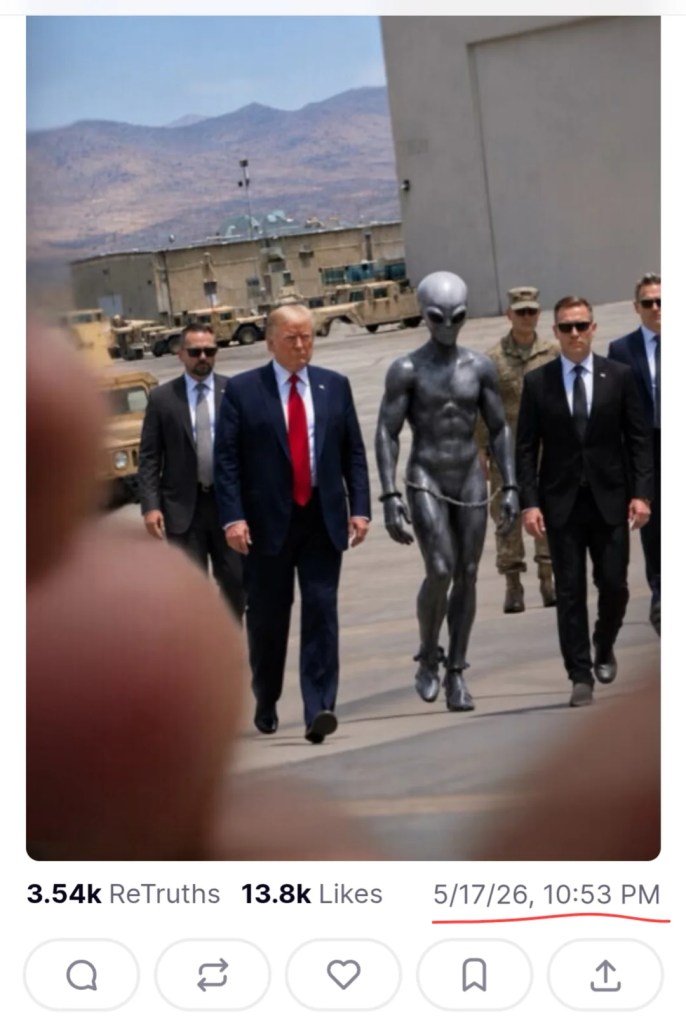
    Last night, President Donald Trump posted an AI generated image of a humanoid alien in chains walking beside him and military officials. The image quickly spread across social media, catching the attention of students, teachers, UFO researchers, skeptics, and curious observers alike.

    The timing is important.

    Just over a week ago, the White House and Department of Defense released the first batch of declassified UAP, or UFO, files, totaling more than 160 documents, photos, videos, and reports. The files include historical records dating back to the 1940s, witness statements, military encounters, and Apollo mission transcripts describing unexplained objects observed during lunar missions.

    While the files do not provide definitive proof of extraterrestrial life, they do confirm something important: governments have taken these phenomena seriously for a very long time.

    According to Pentagon officials, the new UAP archive site received more than 340 million hits within its first twelve hours online, demonstrating an extraordinary level of public curiosity and engagement. Additional releases are expected in the coming weeks, and students will inevitably be part of the conversation.

    So what happens if a student walks into your classroom and asks, “Did you see Trump’s alien post?”

    Do you dismiss it immediately and return to the lesson plan? Or do you recognize that this moment, strange as it may be, opens the door to one of humanity’s oldest questions:

    Are we alone?

    As a veteran teacher, my advice is simple: lean into inquiry.

    Not certainty.
    Not fear.
    Not dismissal.

    Inquiry.

    This is an opportunity to model curiosity, emotional regulation, intellectual humility, media literacy, and critical thinking in real time. Young people are already engaging with these topics online. They are seeing AI images, headlines, rumors, and reactions before many adults have processed them.

    School should be a place where students learn how to think through uncertainty, not avoid it.

    The image itself is also worth examining.

    It does not simply show an alien. It shows a humanoid being in chains, surrounded by military officials and symbols of state power. Whether it was intended as satire, provocation, humor, propaganda, performance art, or symbolism, it raises important questions.

    Why do humans imagine “the other” as dangerous or controllable? Why chains? Why military imagery? Why do AI generated images spread so quickly and shape emotional response so powerfully?

    Students today are growing up in a world where AI generated media can influence perception almost instantly. That alone makes this an important educational moment.

    A simple See, Think, Wonder protocol works well here:

    What do you see?
    What do you think is happening?
    What does this make you wonder?

    You could also begin with broader inquiry questions:

    Why might a president post an image like this?
    What emotions or reactions does it create, and why?
    What is the difference between evidence, satire, propaganda, misinformation, and speculation?
    Why are governments releasing UAP files now?
    Why have humans told stories about mysterious beings in the sky across cultures and history?
    How do we investigate extraordinary claims responsibly?
    What makes a source trustworthy?
    What is the difference between healthy skepticism and automatic dismissal?
    If another species observed humans, what might they notice about us?
    What does our fascination with UFOs reveal about human nature itself?

    The educational possibilities here are enormous.

    Students can explore psychology, mythology, anthropology, astronomy, ethics, artificial intelligence, government transparency, scientific inquiry, and media literacy all through one cultural moment.

    For years, mainstream scientists often dismissed UFO discussions entirely. Neil deGrasse Tyson, for example, became known for publicly mocking UFO claims and emphasizing the lack of scientific evidence. More recently, however, he has taken a more nuanced approach, engaging publicly with the topic and releasing work imagining hypothetical alien encounters through a scientific lens.

    That shift itself is worth discussing with students.

    How do scientific perspectives evolve?
    What changes someone’s mind?
    What counts as evidence?

    This is not about presenting aliens as fact. The goal is not to tell students what to think, but to help them practice how to think.

    History shows us that humans are often certain before new discoveries change what we understand. Germs were once dismissed. Meteors were once considered impossible. Entire historical narratives have shifted with new evidence.

    Science evolves.
    History evolves.
    Human understanding evolves.

    And whether one believes UFOs represent misunderstood technology, psychological phenomena, classified military systems, mythology, nonhuman intelligence, or something else entirely, one thing is undeniably true:

    Millions of people around the world are paying attention right now.

    This is not only a U.S. conversation. Around the world, governments and researchers are beginning to take unidentified aerial phenomena seriously enough to document and study them in structured ways.

    France maintains one of the most transparent systems in the world through GEIPAN, a public database run by its national space agency CNES, where citizens and scientists can access UAP case files and investigations.

    The United Kingdom has released decades of declassified UFO reports through its National Archives, reflecting long-standing governmental interest in documenting unusual aerial sightings.

    In Ukraine, researchers at the Main Astronomical Observatory of the National Academy of Sciences have conducted scientific monitoring of unidentified aerial phenomena using optical tracking systems and observational instruments, contributing data from a region shaped by both military activity and atmospheric complexity. https://arxiv.org/abs/2211.17085 https://arxiv.org/abs/2208.11215

    In Japan, lawmakers and public officials have increasingly discussed the need for structured attention to UAP reports, reflecting a broader international shift toward studying the topic through lenses of security, observation, and scientific inquiry rather than dismissal.

    Taken together, these developments show something important. UAP is no longer confined to one country or one cultural moment. It is becoming a global conversation about evidence, perception, and how humans interpret the unknown.

    What strikes me most is not only that these files are being released, but who is releasing them.

    The conversation is emerging primarily through institutions connected to defense, intelligence, and military power rather than through international scientific collaboration, peace organizations, educators, philosophers, environmental thinkers, or humanitarian groups.

    That should make us pause.

    If humanity is entering a new stage of understanding about ourselves, our planet, or our place in the cosmos, then this conversation cannot belong only to governments or militaries. It also belongs to teachers, students, scientists, artists, historians, ethicists, and ordinary people asking thoughtful questions together.

    Because ultimately, this conversation is not just about UFOs.

    It is about what kind of humans we want to become.

    For further reading:

    Pentagon UFO Files Release Coverage (Euronews)

    Sky News Coverage of the UAP Files

    The Guardian on the Pentagon UFO Release

    Neil deGrasse Tyson on Alien Contact and Scientific Inquiry

  • An invitation

    An invitation

    Hey y’all

    The future is here. As teachers, we feel it every day. I don’t need to tell you how surreal it is. The world our students are growing up in is shifting fast. Artificial intelligence is changing how we think, work, and learn. Climate change and political instability are reshaping what it means to live on this planet. And what was once the stuff of science fiction, like UFOs, is now being discussed in Congress and covered by mainstream news.

    These days, the term UAP, or Unidentified Anomalous Phenomena, is used instead of UFO. “Anomalous” reflects how strange and hard to classify these sightings are. They’re not always in the sky. Some have been reported in oceans or space. Others seem to defy known physics entirely. The term helps make space for the unknown, without assuming too much.

    In recent years, credible sources have begun to acknowledge the existence of phenomena we don’t yet understand.

    And yet, for a long time, topics like these, along with consciousness, non-human intelligence, and alternative knowledge systems, have been silenced by stigma. We’ve been taught not to ask questions that challenge the norm. To keep things simple. Safe. Predictable. But it doesn’t have to be that way anymore.

    If you’ve ever wondered what’s real, what’s true, or what it all means, you’re not alone.

    We don’t need to have all the answers. What we do need is to model intellectual curiosity, humility, and critical thinking—and to make the search for understanding feel like an adventure. As educators, our role is to create space for better questions.

    Questions that stretch our imagination. That cross disciplines. That invite mystery. That make us pause and say, Wait… what? What if?

    We can model what it looks like to live inside the questions. To sit with uncertainty. To wonder openly and stay grounded anyway. That’s what students need—not polished certainty, but the courage to think out loud.

    We don’t need to be experts. We just need to be real.

    Kids love big questions. They want to talk about what truly matters. When we make room for wonder, they lean in. And honestly, we need that wonder too. It’s what keeps us alive in the work.

    Wonder is the antidote to burnout. To disconnection. To apathy. It reminds us why any of this matters.

    Whether you’re skeptical (welcome), curious (you belong here), or already exploring these questions (hello, friend), I welcome you.

    This is a space to challenge what we’ve been told, question assumptions, and open to what else might be true.

    Conversations around UAPs, non-human intelligence, and consciousness are becoming harder to ignore. We’re being invited to rethink science, history, and what it means to be human.

    And maybe, just maybe, religion was more literal than we thought. Maybe ancient stories weren’t just metaphor or myth. They were people’s best attempts to describe real experiences. Mythology, too, may hold truths that were never given the respect they deserved. What have we dismissed too easily because it didn’t fit our frameworks?

    Who decides what counts as knowledge? What stories have been left out? What questions have been dismissed too soon?

    Science was never meant to be a set of fixed answers. It’s a process. History should be a living inquiry, not a closed narrative.

    Educational narratives have long been shaped by colonial systems that marginalized Indigenous epistemologies and excluded knowledge systems that diverged from Western paradigms.

    What if we made room for those, too?

    What if wonder mattered just as much as knowledge?

    What if we prepared students not by handing them facts, but by giving them permission to explore the unknown?

    Right now, conversations about human consciousness are accelerating. Podcasts like The Telepathy Tapes explore our untapped potential. The psychedelic renaissance is bringing together ancient wisdom and modern neuroscience. And across disciplines, more people are asking what it means to truly know, to feel, to connect.

    This work isn’t just for teachers. It’s for school leaders, chaplains, counselors, parents—anyone who cares about how young people make sense of the world.

    I’m not here to convince you of anything. I’m not selling certainty. I’m offering an invitation: to be curious, to wonder, and to ask the questions that don’t yet have answers.

    How do we best serve our kids in this moment?

  • fostering intellectual humility: addressing stigma in education

    fostering intellectual humility: addressing stigma in education

    Deeper Questions for Self-Reflection

    Fostering Intellectual Humility and Navigating Stigma in Education
    Reflective Questions for Educators

    This set of questions invites educators to reflect deeply on their teaching practice, embracing complexity and uncertainty while considering how the role of the teacher may be evolving. Encouraging a balance between openness and critical inquiry, these questions invite you to explore how stigma and fear may limit what is explored in the classroom. Perhaps most importantly, they ask how intellectual humility can be modeled without compromising rigor.


    What questions or topics have you hesitated to explore, either for yourself or with your students? How might concerns about stigma or acceptability influence those boundaries?

    In moments of uncertainty or when faced with unknowns, how do you demonstrate intellectual humility? How can you admit what you don’t know while still guiding and supporting your students confidently?

    What might it look like to bring awe, ambiguity, and curiosity about anomalies into your teaching practice? How could embracing these elements shift not only school culture but also broader societal attitudes toward knowledge and learning?

    How do you foster a safe environment for students to share unusual or deeply personal experiences and perspectives without fear of judgment or dismissal?

    In a rapidly changing world, what kind of educator do you aspire to be? Are you preparing students primarily to recall facts, or to engage with uncertainty and complexity using courage, discernment, and empathy?

    How do you balance openness to new ideas with healthy skepticism and critical thinking? What role does intellectual humility play in maintaining this balance?

  • hello, world!

    hello, world!

    I’m a mother, a teacher, a mystic, and a dancer. At my core, I’m someone drawn to life’s big mysteries. Since I was young, I’ve had experiences that don’t fit within our current models of reality, and I believe others when they say they’ve encountered anomalous phenomenon too.

    In my undergraduate studies, I approached cultural anthropology through an interdisciplinary lens, exploring women’s studies and religion with a particular focus on psychological and symbolic frameworks.

    It was there that I experienced a profound ontological shock, the kind that unsettles your foundation and forces you to see the world differently. When I encountered the concept of the ancient goddess, it felt like uncovering a true mystery that had been hidden for centuries. I began to see how history had been rewritten, how vast and vital stories had been erased, and how those erasures continue to shape what we believe to be true.

    It was not just an academic realization. It was personal, emotional, and deeply disorienting. I began to ask questions that shook me at my core: Why was this knowledge hidden? Who benefited from keeping it buried? What has been the impact on individuals and society of living without this information? Who might we be if we knew that an ancient goddess was replaced by a male god? How did that shift affect power structures, cultural values, and the control of gender?

    This awakening sparked a lifelong search for what lies beneath the surface, for the truths that have been silenced, distorted, or forgotten. It taught me to question everything and to hold space for complexity, nuance, and mystery.

    That’s why I teach. Also, because kids are just the best of human beings. I teach not just to share knowledge but to help young people navigate their own questions. I want them to trust their curiosity, ask beautiful questions, and feel comfortable and even inspired with the unknown.

    Now, as we stand on the edge of a paradigm shift with Unidentified Anamolous Phenomena (UAPs), Artificial Intelligence (AI), and the possibility of non-human intelligences (NHI) entering the conversation, I feel called and ready to help others navigate this change.

    Truthfully, the kids are already really open; it is the adults I am worried about :)

  • rethinking education: what does It mean to be human?

    rethinking education: what does It mean to be human?

    This is the question I’ve spent my life exploring, with children, educators, and communities. It’s the thread that runs through everything I do: teaching, curriculum design, the humanities, justice work, mindfulness, and now helping others navigate the unfolding reality of UAPs and Non-Human Intelligence (NHI).

    For centuries, we’ve explored this question through history, science, religion, literature, and philosophy. We’ve defined ourselves by our intellect, creativity, compassion, and desire to make meaning. Some of the stories we’ve told about ourselves have been expansive and beautiful. Others have been limiting or exclusionary.

    But today, something is shifting. If we are not alone in the universe, if there are other forms of life, intelligence, or consciousness, what does that mean for how we understand ourselves?

    How do we define what it means to be human if we are not the only ones asking the question?


    Expanding Our Definition

    For too long, education has centered on delivering the “right” answers. But now, more than ever, we need the courage to ask better questions.

    In my teaching, I invite children to wonder freely. Together, we explore:

    • Do you consider humans animals?
    • What makes us similar to other animals? What makes us different?
    • What might explain those differences?
    • How do we treat other species in science and industry? What does that reveal about our values?
    • What if another species treated us the way we treat animals?
    • What if humans are not the pinnacle of creation?
    • What else on this planet might be sentient?
    • How might other animals or beings experience reality in ways we cannot imagine?

    These are no longer just imaginative or philosophical questions. They now live at the edge of science, history, and spirituality. And they are becoming more timely and real.


    Rethinking Education

    As new information emerges and challenges our assumptions, we have an opportunity to rethink the very purpose of education.

    Education should not be a conveyor belt of facts. It should be a space where we learn to hold questions. A space for imagination, empathy, and critical thinking. A place where we unlearn what no longer serves us and begin to see the world, and ourselves, with new eyes.

    This is not about replacing one worldview with another. It’s about learning to live with complexity. To remain curious and open in the face of mystery.

    If the unknown includes forms of intelligence beyond humanity, or beyond Earth, then the classroom becomes more than a site of knowledge. It becomes a space for deep, transformative inquiry.


    Practicing Inquiry Together

    These questions are not abstract. They can be brought into real classrooms with real students, right now, as journaling prompts, circle discussions, art explorations, or collaborative projects.

    Here are a few that can guide inquiry:

    • What makes us human?
    • What assumptions do we hold about our uniqueness or superiority?
    • Are we alone in the universe? What do you believe, and why?
    • How might other forms of life experience reality?
    • What counts as sentience, and who gets to decide?
    • What stories or cultural traditions suggest we’ve been connected to other intelligences?
    • How has knowledge about other beings or deeper human potential been dismissed, hidden, or controlled?
    • Who decides what is real or valid knowledge?

    When we explore these questions together, we practice exactly the kind of thinking and courage this moment asks of us.


    A New Chapter

    As we step into the next chapter of human history, we will need more than just new technologies. We will need new ways of knowing and being. We’ll need empathy, imagination, and a willingness to stretch our understanding beyond old boundaries.

    This is the spirit of education I believe in.

    Not one that prepares students only for college or tests, but for the mystery of existence itself. One that honors our place in a vast, complex universe. One that teaches us how to ask honest questions, and how to live with them.

    So I’ll ask again:

    What do you think it means to be human?

  • Why Epistemology Matters More Than Ever

    Why Epistemology Matters More Than Ever

    Epistemology is about knowledge. It asks how we know what we know, why we believe it, and what counts as truth. It challenges us to look at what we’ve accepted without question and to wonder what might still be missing.

    In schools, what we teach—and just as importantly, what we leave out—shapes how students see the world and their place in it. Science is often taught as a fixed set of answers instead of a way to ask better questions. History is treated like a closed book, not an evolving record shaped by power, perspective, and silence. The humanities get pushed aside, labeled soft or extra, instead of being treated as vital tools for understanding what it means to be human.

    But the world is changing. The questions are getting bigger. And we need thinkers who are ready.

    We need ethicists, mystics, dreamers, artists, and scientists who can hold complexity, sit with the unknown, and imagine new paths forward. Technical skill is important, but it’s not enough. We also need wisdom, discernment, curiosity, and heart.

    That’s why epistemology belongs in our classrooms. It invites students to ask:

    What is real?
    Who decides?
    What happens when our old answers no longer fit the questions?

    Because reality is shifting. New stories are rising. Paradigms are cracking. If we aren’t teaching students how to question, how to stay curious, how to sit with uncertainty and still stay grounded, we aren’t preparing them for the world that’s coming.

    Here are the kinds of questions that matter now:

    • What happens when epistemology becomes part of the curriculum?
    • How do you define what is real? What do you define as not real?
    • Is reality objective, subjective, or something else entirely?
    • How do perception and bias shape what we see and understand?
    • How has knowledge—about other intelligences or even our own human potential—been dismissed, hidden, or tightly controlled?
    • Who gets to decide what counts as science or history?
    • What stories are we handing down, and what truths are we leaving out?
    • Are we teaching students to think critically or just to fit in?

    Let’s raise a generation that questions, imagines, and stays awake. Let’s teach them how to build something new from the ground up.