Why teachers should respond with inquiry, not ridicule.
When UFOs Enter the Classroom
Why educators should respond with inquiry, not ridicule
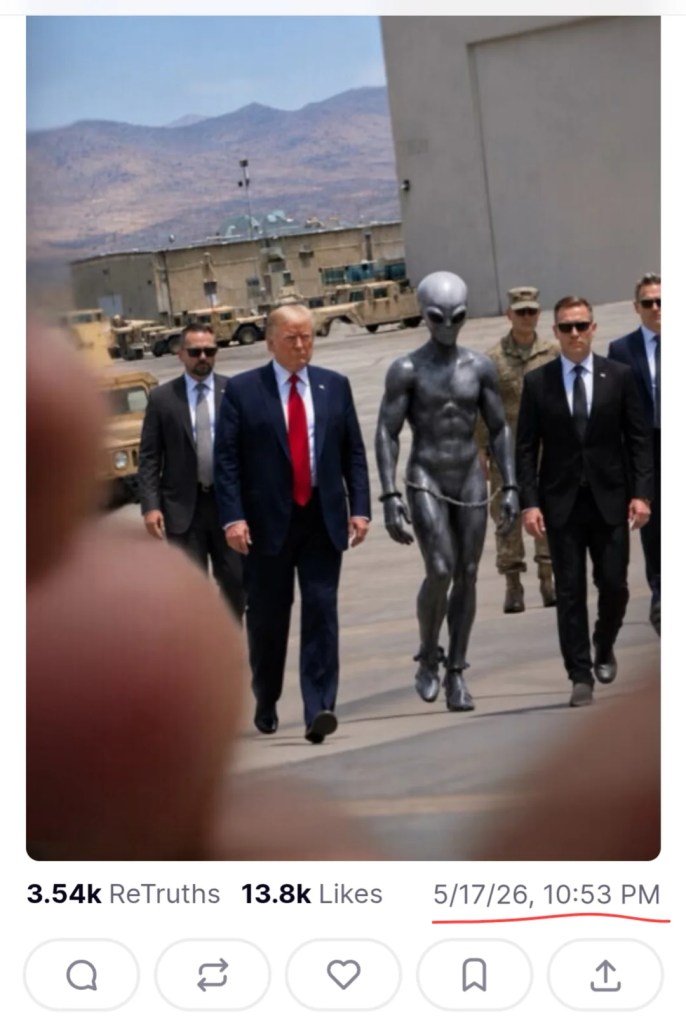
Last night, President Donald Trump posted an AI generated image of a humanoid alien in chains walking beside him and military officials. The image quickly spread across social media, catching the attention of students, teachers, UFO researchers, skeptics, and curious observers alike.
The timing is important.
Just over a week ago, the White House and Department of Defense released the first batch of declassified UAP, or UFO, files, totaling more than 160 documents, photos, videos, and reports. The files include historical records dating back to the 1940s, witness statements, military encounters, and Apollo mission transcripts describing unexplained objects observed during lunar missions.
While the files do not provide definitive proof of extraterrestrial life, they do confirm something important: governments have taken these phenomena seriously for a very long time.
According to Pentagon officials, the new UAP archive site received more than 340 million hits within its first twelve hours online, demonstrating an extraordinary level of public curiosity and engagement. Additional releases are expected in the coming weeks, and students will inevitably be part of the conversation.
So what happens if a student walks into your classroom and asks, “Did you see Trump’s alien post?”
Do you dismiss it immediately and return to the lesson plan? Or do you recognize that this moment, strange as it may be, opens the door to one of humanity’s oldest questions:
Are we alone?
As a veteran teacher, my advice is simple: lean into inquiry.
Not certainty.
Not fear.
Not dismissal.
Inquiry.
This is an opportunity to model curiosity, emotional regulation, intellectual humility, media literacy, and critical thinking in real time. Young people are already engaging with these topics online. They are seeing AI images, headlines, rumors, and reactions before many adults have processed them.
School should be a place where students learn how to think through uncertainty, not avoid it.
The image itself is also worth examining.
It does not simply show an alien. It shows a humanoid being in chains, surrounded by military officials and symbols of state power. Whether it was intended as satire, provocation, humor, propaganda, performance art, or symbolism, it raises important questions.
Why do humans imagine “the other” as dangerous or controllable? Why chains? Why military imagery? Why do AI generated images spread so quickly and shape emotional response so powerfully?
Students today are growing up in a world where AI generated media can influence perception almost instantly. That alone makes this an important educational moment.
A simple See, Think, Wonder protocol works well here:
What do you see?
What do you think is happening?
What does this make you wonder?
You could also begin with broader inquiry questions:
Why might a president post an image like this?
What emotions or reactions does it create, and why?
What is the difference between evidence, satire, propaganda, misinformation, and speculation?
Why are governments releasing UAP files now?
Why have humans told stories about mysterious beings in the sky across cultures and history?
How do we investigate extraordinary claims responsibly?
What makes a source trustworthy?
What is the difference between healthy skepticism and automatic dismissal?
If another species observed humans, what might they notice about us?
What does our fascination with UFOs reveal about human nature itself?
The educational possibilities here are enormous.
Students can explore psychology, mythology, anthropology, astronomy, ethics, artificial intelligence, government transparency, scientific inquiry, and media literacy all through one cultural moment.
For years, mainstream scientists often dismissed UFO discussions entirely. Neil deGrasse Tyson, for example, became known for publicly mocking UFO claims and emphasizing the lack of scientific evidence. More recently, however, he has taken a more nuanced approach, engaging publicly with the topic and releasing work imagining hypothetical alien encounters through a scientific lens.
That shift itself is worth discussing with students.
How do scientific perspectives evolve?
What changes someone’s mind?
What counts as evidence?
This is not about presenting aliens as fact. The goal is not to tell students what to think, but to help them practice how to think.
History shows us that humans are often certain before new discoveries change what we understand. Germs were once dismissed. Meteors were once considered impossible. Entire historical narratives have shifted with new evidence.
Science evolves.
History evolves.
Human understanding evolves.
And whether one believes UFOs represent misunderstood technology, psychological phenomena, classified military systems, mythology, nonhuman intelligence, or something else entirely, one thing is undeniably true:
Millions of people around the world are paying attention right now.
This is not only a U.S. conversation. Around the world, governments and researchers are beginning to take unidentified aerial phenomena seriously enough to document and study them in structured ways.
France maintains one of the most transparent systems in the world through GEIPAN, a public database run by its national space agency CNES, where citizens and scientists can access UAP case files and investigations.
The United Kingdom has released decades of declassified UFO reports through its National Archives, reflecting long-standing governmental interest in documenting unusual aerial sightings.
In Ukraine, researchers at the Main Astronomical Observatory of the National Academy of Sciences have conducted scientific monitoring of unidentified aerial phenomena using optical tracking systems and observational instruments, contributing data from a region shaped by both military activity and atmospheric complexity. https://arxiv.org/abs/2211.17085 https://arxiv.org/abs/2208.11215
In Japan, lawmakers and public officials have increasingly discussed the need for structured attention to UAP reports, reflecting a broader international shift toward studying the topic through lenses of security, observation, and scientific inquiry rather than dismissal.
Taken together, these developments show something important. UAP is no longer confined to one country or one cultural moment. It is becoming a global conversation about evidence, perception, and how humans interpret the unknown.
What strikes me most is not only that these files are being released, but who is releasing them.
The conversation is emerging primarily through institutions connected to defense, intelligence, and military power rather than through international scientific collaboration, peace organizations, educators, philosophers, environmental thinkers, or humanitarian groups.
That should make us pause.
If humanity is entering a new stage of understanding about ourselves, our planet, or our place in the cosmos, then this conversation cannot belong only to governments or militaries. It also belongs to teachers, students, scientists, artists, historians, ethicists, and ordinary people asking thoughtful questions together.
Because ultimately, this conversation is not just about UFOs.
It is about what kind of humans we want to become.
For further reading:
Pentagon UFO Files Release Coverage (Euronews)
Sky News Coverage of the UAP Files
 wonderstanding
Leave a comment