
“We can travel to the stars or return to the Stone Age with this technology.”
-Dylan Borland, UAP Task Force Hearing, opening statements
Restoring Trust in a Topic Nobody Knows About
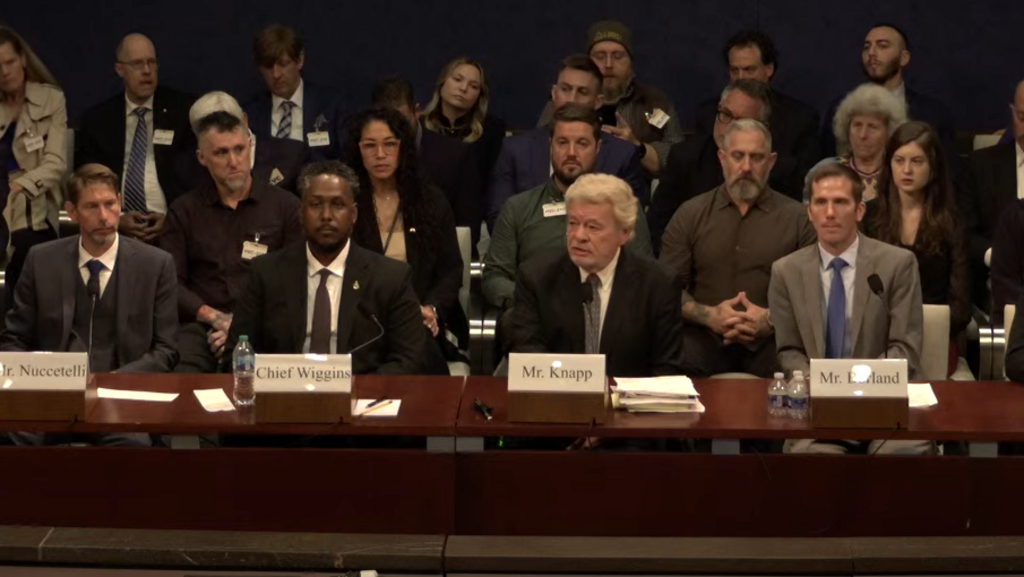
Today, the Task Force on the Declassification of Federal Secrets held a hearing titled Restoring Public Trust Through UAP Transparency and Whistleblower Protection. This link leads to the White House’s official summary of the event. The title of the event sounds official and reassuring, but most people do not even know these objects exist. So whose trust are we really restoring?
The three-hour meeting is linked here, along with each of the written testimonies, though you couldn’t even find it on C-Span. Perhaps one day we will look back at these hearings as historical, but for now, you have to be an investigator to even know they are happening.
Right now, mainstream media mostly will not touch the topic, except to show a fuzzy video complimented with X-Files music and a giggle. I encourage you to ahead and do a google news search to see what you find. You would think that five people under oath, describing enormous craft in the sky that defy our current understanding of science, would make headlines: UFOs are real! We aren’t alone! I give a shout-out to USA Today for even trying to get normal folks up to speed. That’s why I’m writing this, to spark conversation, normalize the topic, and invite us to wonder: who are we, who are they, and what can their existence teach us about ourselves?
The Testimony

This meeting was a whopper in every sense. Five brave whistleblowers testified about UAPs. These gentlemen were under oath, knowing that if they did not speak the truth but not too much of it, the consequences could be dire. They shared not only what most people would call outlandish stories, but also risked their jobs, families, and lives. You could hear the emotion in their voices, the weight of what they had lost, their fear, and their carefulness.
They are heroes, sacrificing everything for what they know is right. Telling the truth, even when it is excruciating, is an act of courage. These men have carried secrets for years, probably thinking they were half crazy, and finally chose to step into the light. The main purpose of the hearing was to advance whistleblower protection, and it became immediately clear that those who came forward needed it. They risked careers, reputations, and even personal safety.
Diversity of Craft

This footage has garnered significant attention, but it’s just one example among many discussed during the testimony. As we all know, the adage “seeing is believing” is increasingly complex in today’s world. Even the most discerning experts (and I am fortunate to know some of them) are uncertain about the nature of this video, though it undeniably depicts something extraordinary.
Rep. Eric Burlison presented radar footage from October 30, 2024, showing an MQ-9 Reaper drone launching a “Hellfire” missile at a glowing orb off the coast of Yemen. Astonishingly, the missile made contact with the object but appeared to have no effect, continuing its trajectory into the sea. Journalist George Knapp testified that numerous similar videos exist but have not been released to Congress or the public. This “incident” raises profound questions about the capabilities of UAP, the limitations of current military technology, and the ethical and societal challenges we must confront. More on that later.
Chief Alexandro Wiggins recounted seeing a self-luminous Tic Tac-shaped object (these are quite common) emerge from the ocean and link up with three others off the coast of Southern California in 2023. Jeffrey Nuccetelli shared a sighting of a massive glowing red square silently hovering over Vandenberg Air Force Base in 2003. Later, security guards at the same base reported a bright, fast-moving object over the ocean that same evening.
Dylan Borland testified about a 100-foot triangular craft over Langley Air Force Base in 2012, moving rapidly and silently. His testimony nearly made me cry. His vulnerabilty and fear were so apparent alongside his bravery.
In each of these testimonies, the witnesses were not alone, in fact, they were often with several other people seeing the same thing.
Deep Parallels

Several patterns emerged from the testimonies that hint at a bigger picture. One well-known in the UFO community is that these craft often appear over water. Let that sink in. Why might they be drawn to water? Are they from the water? From another planet with water? Do they somehow use it as fuel? Is it an ideal place to hide? Could another civilization exist in our oceans, far older than ours? These questions first pulled me into the UFO rabbit hole and continue to spark my imagination and creativity. I am working on a project exploring these ideas, more on that soon.
Another consistent pattern is their unusual flight characteristics. Witnesses describe objects that hover silently, move at impossible speeds, or behave in ways that defy physics as we understand it. Sudden appearances and disappearances suggest advanced control or stealth capabilities.
Adding another layer, repeated interactions with human technology show that these craft are not merely random. They have appeared near nuclear sites, interfered with weapons, and approached military aircraft without causing harm. These behaviors are deliberate and repeat across time, locations, and branches, challenging both our physics and our assumptions about human perception.
Finally, the testimonies highlight uneven knowledge within our own systems. The Navy has historically shared more than the Air Force, which remains famously secretive. Even in our structured institutions, awareness of these phenomena is inconsistent, revealing that we are only glimpsing pieces of a much larger puzzle.
Taken together, these patterns—preference for water, extraordinary flight capabilities, deliberate technological interaction, and uneven human knowledge—suggest a phenomenon that is both systematic and deeply mysterious. The witnesses’ accounts invite us not only to wonder about the craft themselves but to reflect on what they reveal about our own assumptions and limitations.
Ethics and Human Reactions
What stayed with me most after these testimonies was not just the craft or the videos. It was how we, as humans, respond when faced with something far beyond our understanding. I cannot overstate it. I am unsettled that we fired on an “alien” ship. This is not the first time this has happened, mind you, but when one human makes that decision for all of humanity, representing all of us, I have issues.
Who gave that order? Who was claiming to speak for all of humanity? Why react with aggression toward an intelligence that clearly far surpasses us?
A society capable of this technology has likely found ways to survive without self-destruction, a level of control and civility humans struggle to reach. Watching these hearings, I kept coming back to this. The biggest lesson is not about them. It is about us. How will we rise or fail when confronted with the truly unknown?
UAP and Technology
The testimony echoes decades of reports showing UAPs’ interest in our technology, particularly near nuclear sites. They have hovered near nuclear sites and even disabled weapons. In May 2001, Dr. Steven Greer hosted the Disclosure Project press conference at the National Press Club in Washington, D.C. He presented over 20 witnesses, many of whom were former military, government, and intelligence officials, who described firsthand incidents involving UFOs, advanced propulsion technology, and interactions with nuclear weapons systems.
This is well documented in Robert Hastings’ book UFOs & Nukes, which compiles interviews with over 150 veterans and thousands of declassified documents.
In yesterday’s testimony, witnesses described craft flying over sensitive defense installations. These objects appear to only disable weapons. Why? To disarm us, to prevent us from destroying our planet, or because they have an invested interest in our survival? Could it be that they live here too? Which brings me back to water.
Language Matters: UAP, NHI, and “Extraterrestrial”
One of the trickiest parts of this topic is what we call these things. Unknown craft are often labeled “extraterrestrial,” but that word can be misleading. “Alien” could mean many things. It could be a being from another planet, another dimension, or an intelligence that exists in ways we cannot yet comprehend. Our current science cannot confirm any of these possibilities. If you ask a witness under oath whether a craft is extraterrestrial, they cannot truthfully say yes without risking perjury or embarrassment. The word provides deniability.
This is why new terms like UAP (Unidentified Aerial Phenomenon) and NHI (Non-Human Intelligence) matter. UAP refers to the craft itself, while NHI refers to any sentient being associated with it. Many conflate the two, assuming every craft is piloted. In reality, not all craft are manned, and not all beings travel in ships.Keeping these concepts separate helps us stay precise, think critically, and avoid jumping to conclusions based on Hollywood ideas.
The Schumer Amendment and related legislation reflect this shift in language. UAP and NHI appear multiple times in the text, giving Congress a framework to discuss these phenomena without defaulting to “extraterrestrial.” The law has been watered down from its original proposals, which included independent review boards and stricter reporting requirements, and it is now back up for further legislation. Using these neutral terms opens the door for serious study and inquiry rather than forcing evidence into preconceived narratives. By codifying UAP and NHI, the amendment reinforces the importance of precise, neutral terminology.
The Schumer Amendment, part of the 2024 National Defense Authorization Act, defines Non-Human Intelligence as follows:
NON-HUMAN INTELLIGENCE. The term “non-human intelligence” means any sentient intelligent non-human lifeform regardless of nature or ultimate origin that may be presumed responsible for unidentified anomalous phenomena or of which the Federal Government has become aware.
The term “UAP” is also defined in the amendment:
UNIDENTIFIED ANOMALOUS PHENOMENA.
In general. The term “unidentified anomalous phenomena” means any object operating or judged capable of operating in outer space, the atmosphere, ocean surfaces, or undersea that lacks prosaic attribution due to performance characteristics and properties not previously known to be achievable based upon commonly accepted physical principles. Unidentified anomalous phenomena are differentiated from both attributed and temporarily non-attributed objects by one or more of the following observables:
- Instantaneous acceleration absent apparent inertia
- Hypersonic velocity absent a thermal signature and sonic shockwave
- Transmedium travel, such as space-to-ground and air-to-undersea
- Positive lift contrary to known aerodynamic principles
- Multispectral signature control
- Physical or invasive biological effects to close observers and the environment
Paying attention to language allows us to ask better questions about these phenomena. Who or what is behind them? How do they interact with our technology? What does their existence, whether terrestrial, interdimensional, or something else entirely, say about the universe and about us?
Government officials have sometimes used the term “interdimensional” to describe certain encounters. Cultural and spiritual traditions interpret these entities as angels, demons, or other non-human intelligences. Acknowledging these interpretations while remaining open to other possibilities is important. Neutral language allows us to explore all perspectives and think critically without forcing a single narrative.
If you are curious, I put together a brief guide exploring alternative explanations to the ‘extraterrestrial’ hypothesis here.
Government and Transparency
The overarching theme? Congress has very limited knowledge of what is actually happening. They are frustrated. Lockheed Martin was mentioned several times, as were Bob Bigelow and, surprisingly, Bob Lazar. Lazar’s claims about back-engineered alien technology and work near Area 51 remain controversial but continue to be a touchstone in the UFO community.
George Knapp, a journalist in Nevada, was an outstanding witness. He referenced the 1952 flyovers of Washington, D.C., not once but twice, which I loved. People often say, “Why don’t they just fly over the White House?” Well, they did. These sightings, tracked by radar and eyewitnesses, are now part of the congressional record.
Luna earned cheers when she said she would subpoena Sean Kirkpatrick, former head of AARO, reflecting widespread frustration among UAP investigators. She literally called him a known liar, which felt like a victory for those of us who have been following these cases closely.
AARO, the All-domain Anomaly Resolution Office, was created by the Department of Defense in 2022 to consolidate UAP reporting, analysis, and investigation across all military branches. Its stated mission is to identify, assess, and mitigate potential threats posed by UAPs to national security while coordinating with other government agencies. Under Sean Kirkpatrick’s leadership, AARO reported most sightings as misidentified objects, including balloons, birds, UAVs, or airborne debris. On paper, AARO looked like it was doing serious work, but in practice it often felt like a cover story. It was an office that gave the appearance of investigation while quietly sending the message, “Move along, nothing to see here.”
During the hearing, the reporting process came across as confusing and, at times, absurd, very much like the old Project Blue Book days. Programs like the Airborne Object Identification and Management Synchronization Group (AOIMSG) sounded like alphabet soup and felt designed to bewilder rather than clarify. On paper, it looked like the Department of Defense was taking UAPs seriously, but the way information was handled suggested a lot of window dressing, an effort to appear investigative while keeping the real story under wraps.
Lockheed Martin was mentioned multiple times in connection with UAP crash retrievals and reverse engineering efforts. Investigative journalist George Knapp testified that, in the early 2000s, Robert Bigelow’s company, Bigelow Aerospace Advanced Space Studies (BAASS), negotiated with Lockheed Martin to acquire unusual materials stored at a facility in California. These materials were reportedly not manufactured on Earth and exhibited characteristics suggesting they were crafted in a zero-gravity environment, possibly in space.
Despite these claims, the Department of Defense has consistently denied the existence of programs focused on retrieving or reverse-engineering extraterrestrial technology. An official report from the All-domain Anomaly Resolution Office (AARO) states that a program was expanded in 2021 to include UAP reverse-engineering efforts but was disestablished due to inactivity and lack of merit.
This discrepancy raises several questions: If such materials exist, how are they being utilized? Why hasn’t Congress been fully informed? And why do humans often seek to weaponize discoveries instead of exploring peaceful applications? Imagine the potential benefits if such technologies were used for energy, transportation, or environmental solutions.
Bipartisan Breakthrough
This hearing was remarkable for its rare bipartisan bicameral unity. Representatives from both parties, including Chairwoman Anna Paulina Luna (R-Fla.), Rep. Tim Burchett (R-Tenn.), Rep. Eric Burlison (R-Mo.), and Rep. Jasmine Crockett (D-Texas), demanded transparency and accountability. As Rep. Crockett noted, “This is what governing looks like, working together to uncover the truth.”
It underscores that the quest for truth about UAPs transcends party lines. At this moment in time, working across party lines is a small miracle. Curiosity, ethics, and the drive to know the truth belong to all humans, not political affiliations.
Closing Reflection
What I carry from today is not just the craft, the videos, or the controversy. It is the human element, the courage, the ethics, and the long, difficult journey that brought us here. We have made progress in acknowledging UAPs through official channels, but much work remains.
I am inspired to create lesson plans for teachers, students, and anyone curious about the science, ethics, and human stories behind these phenomena. Looking closely at this topic raises so many important questions, questions that demand curiosity, care, and a willingness to think beyond what we already know.

 wonderstanding